U of I Ecotron team leads Palouse Prairie Charter School students in composting research
MOSCOW, Idaho — May 20, 2026 — Palouse Prairie Charter School seventh-grader Leo Hufstutler now views soil as a living organism and school lunch waste as a potential nutrient-rich resource based on findings of a three-week science experiment facilitated by University of Idaho researchers.
Michael Strickland, a professor in the Department of Soil and Water Systems, has helped the Moscow-based public school’s seventh-graders set up and run annual soil-related science experiments throughout the past decade. For Hufstutler, the experiment ranked among the top two most memorable activities of the school year.
“Personally, I want to understand how the world works,” Hufstutler said. “Bacteria isn’t always bad if it’s in the soil. If you’re trying to make some crops grow, it’s actually very good.”
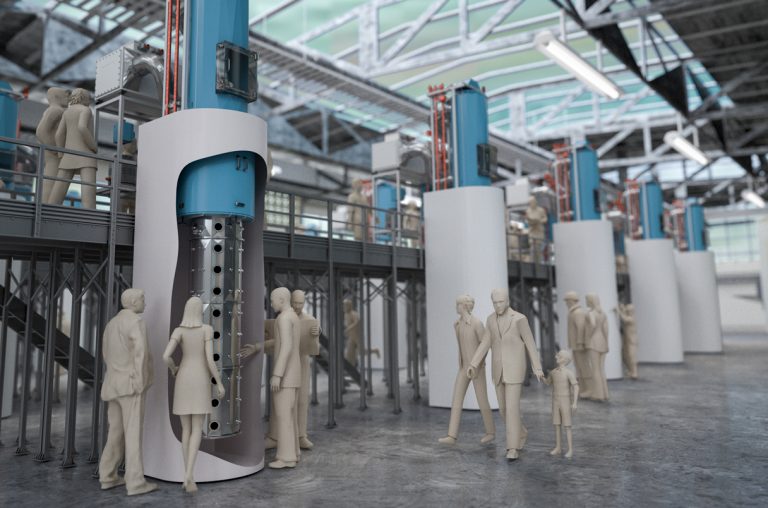
Strickland is principal investigator of U of I’s new Deep Soil Ecotron, which includes 10-ton chambers, called lysimeters, in which researchers can manipulate and study soil ecosystem processes and microbial communities at previously unexplored depths. A Cenex Harvest States Foundation grant intended to provide education and outreach associated with the Ecotron funded the Palouse Prairie research project, including supplies and equipment such as soil probes, jars and inoculum and staff time from Melissa Renfrow, Ecotron education coordinator.
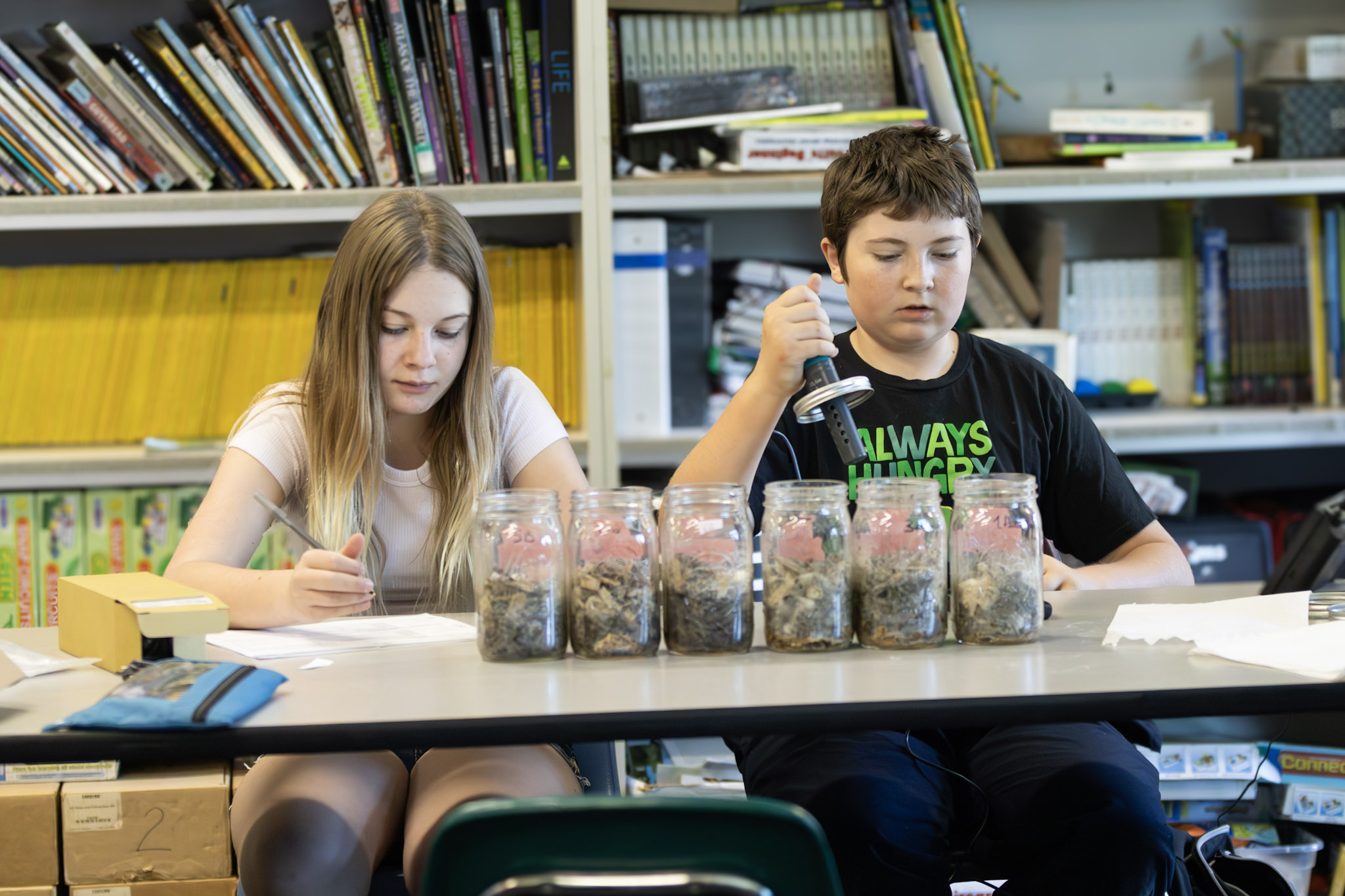
The students’ mason jars were essentially miniature Ecotrons, each equipped with a sensor for measuring carbon dioxide emissions as a means of tracking the decomposition rate of thefeedstock.
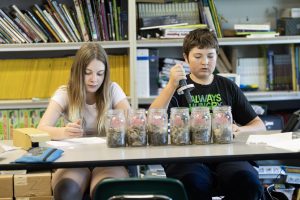
“What students at Palouse Prairie are experiencing with the compost experiment is essentially a simplified model of what faculty and researchers study at the Deep Soil Ecotron,” Renfrow said. “When they test how different carbon to nitrogen ratios affect decomposition and carbon dioxide production, they’re exploring the same core processes — microbial activity, nutrient cycling and carbon movement.”
In addition to learning soil science, Hufstutler believes she and her classmates gained an appreciation for being responsible in handling sensitive equipment and carefully following directions to avoid skewing the results. The students took carbon dioxide measurements from their jars three times per week, graphed the data and interpreted the results in a report.
“My favorite part was when we finally made all of the tables into graphs instead of just numbers and could see the lines showing how all the levels had changed,” Hufstutler said.
The Palouse Prairie seventh-graders studied jars with blends of lunch waste and wood chips with a carbon-to-nitrogen ratio of either two to one or five to one. They found a ratio with two parts carbon to one part nitrogen optimized microbial activity. A key part of the experiment involved comparing jars with microbial inoculants against jars with sterilized microbes, as well as a control group with no added microbes.
“Mike Strickland as a soil scientist was curious. A lot of times people who want compost wonder if it’s worth inoculating,” said Andrika Kuhle, who teaches the seventh-grade class. “We added living inoculant and we autoclaved some of the inoculant because the question was if the benefit came simply due to adding nutrients.”
Palouse Prairie’s charter is based on the EL Education model, which evolved from Outward Bound and the Harvard School of Education and emphasizes experiential learning. Soil science experiments at the kindergarten- through eighth-grade school typically build upon student-led research from prior years. In 2019, Strickland led one seventh-grade class in analyzing the soil at the campus, which they confirmed was depleted in carbon and microbial activity. The class recommended the addition of compost and other carbon-rich material to restore the soil.
The 2026 class has also built a composting system for their school to repurpose lunch waste. Future classes will use the composting system, as well as composting recommendations from the seventh-graders resulting from their recent experiment, to produce compost to enhance soil on the school campus prior to landscaping it with native plants.
“This is real research. It’s way more interesting than reading about something,” Kuhle said. “Having real-world opportunities like this inspires the students.”
Strickland and his colleagues plan to develop standardized curriculum and kits based on the experiment to share with junior high science teachers throughout the state. They’ll choose three to six Idaho junior high teachers with a background in soil science to pilot test the kits this fall.
Media Contact:
John O’Connell
Assistant Director of Communications, College of Agricultural and Life Sciences
208-530-5959
joconnell@uidaho.edu